Content
A strut channel roll forming machine is a continuous metal forming system that progressively bends flat steel coil stock into strut channel profile — the open-section, slotted structural framing component used throughout construction, electrical, mechanical, and industrial installations. The machine converts a flat steel strip into a finished strut channel section in a single inline pass, from decoiling through forming, punching, and cut-off, at production rates typically ranging from 10 to 40 meters per minute depending on configuration and profile complexity.
Strut channel — also sold under trade names such as Unistrut, Superstrut, and Atkore — is one of the highest-volume roll formed profiles in the construction hardware industry. Its characteristic C or U cross-section with inward-turned lips and a continuous series of 9/16" (14.3 mm) slotted holes along the web is produced to dimensional standards including NEMA FG-1, ASTM A1011, and international equivalents. A dedicated roll forming machine optimized for this profile can produce this geometry to tolerances of ±0.3 mm on web width and ±0.5° on lip angle across the full production run.
The roll forming process is inherently suited to strut channel production because the profile's geometry — consistent cross-section, high length-to-width ratio, and requirement for inline hole punching — maps directly to roll forming's strengths: high throughput, dimensional consistency across long production runs, and the ability to integrate secondary operations such as punching and embossing inline without additional handling.
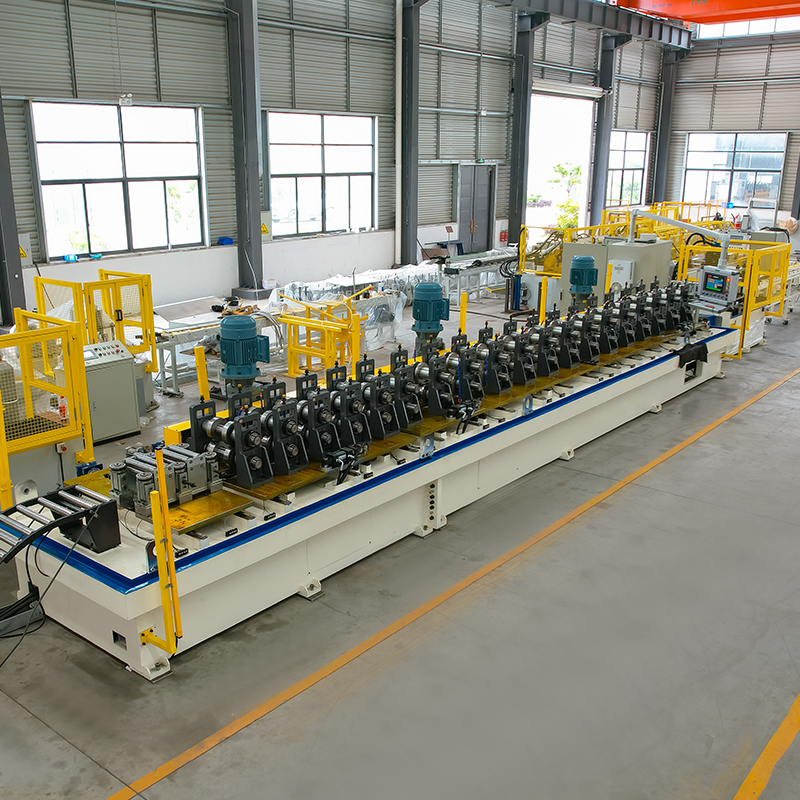
A complete strut channel roll forming line is an integrated sequence of stations, each performing a specific operation as the strip moves continuously from entry to exit. Understanding each station's role is essential for evaluating line specifications, troubleshooting, and planning a production facility layout.
The decoiler holds the raw steel coil — typically 1,000–5,000 kg — on a mandrel and controls the payout tension as the strip feeds into the line. Hydraulic expanding mandrels are standard on modern lines, allowing rapid changeover between different coil inner diameters. The straightener follows the decoiler with a series of offset rolls (typically 7–11 rolls) that flatten the coil set — the natural curvature the strip retains from being wound — before it enters the forming section. Residual coil set that is not corrected by the straightener will produce a finished channel that curves along its length rather than running straight.
The slotted holes in strut channel web are punched before the profile is formed, not after — a configuration called pre-punching. Punching flat stock is far simpler and more accurate than punching a formed C-section, where tool access to the web is restricted by the formed lips. The pre-punch press is a servo-driven or cam-driven mechanical press with a die set configured for the standard 9/16" × 1-1/8" (14.3 × 28.6 mm) slots at the specified pitch (typically 1-7/8" or 47.6 mm center-to-center for standard strut). Hole pitch accuracy is critical — a cumulative pitch error that grows along the coil length will produce channels whose holes do not align when channels from different production batches are assembled together on site.
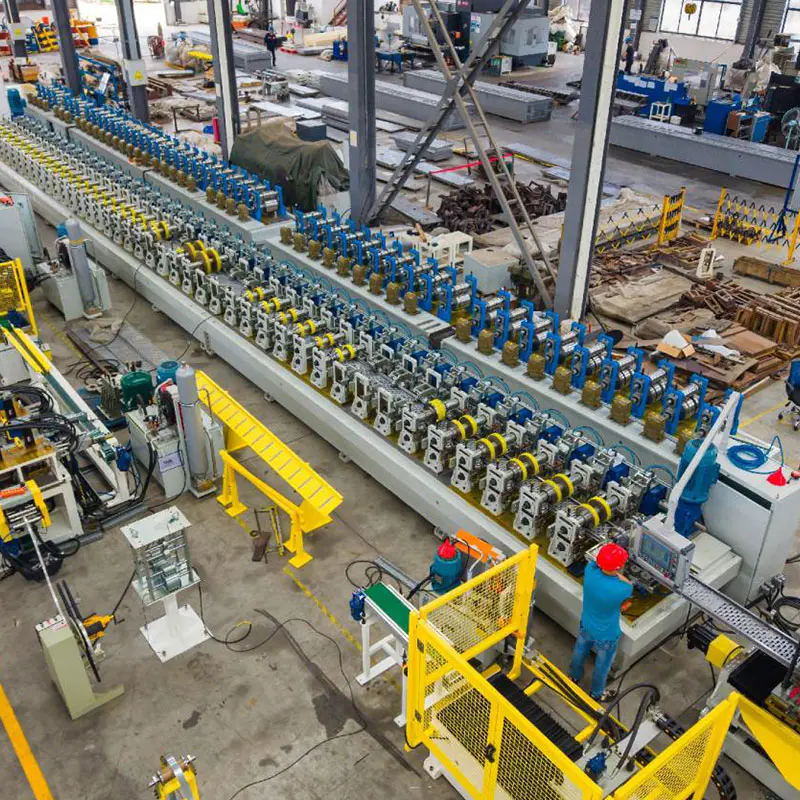
The forming mill is the core of the line — a series of paired upper and lower roll tooling stations mounted in a rigid frame, each incrementally bending the strip closer to the final profile. A standard strut channel profile requires 12–18 forming stations, with the number depending on material thickness, bend angle severity, and the required surface quality. Each station's rolls are precision-machined to a specific forming angle, and the stations are designed as a progressive sequence: early stations make gentle bends; later stations close the lips and set the final geometry. Roll diameter, roll material (typically D2 or H13 tool steel, hardened to 58–62 HRC), and roll surface finish directly determine the dimensional precision and surface quality of the finished channel.
At the exit of the forming mill, a flying cut-off press separates the continuous formed section into individual lengths. The cut-off die travels with the strip during the cutting stroke — maintaining synchronization with the production line speed — then returns to its start position for the next cut. This flying motion eliminates the need to stop the line for each cut, enabling continuous high-speed production. Standard strut channel lengths are 3 m (10 ft) and 6 m (20 ft), with cut length controlled by encoder-based length measurement and servo positioning accurate to ±1 mm across the production run.
Cut lengths exit onto a run-out table — a roller conveyor that supports the channel as it decelerates from line speed. Automated stacking systems then bundle the cut lengths into counted packs for downstream handling, banding, and dispatch. On high-volume lines producing 10,000+ meters per shift, automated stacking with robotic or mechanical bundling significantly reduces labor cost and the handling damage that results from manual stacking of long, heavy channel sections.
The strut channel roll forming machine must be specified and set up for the material range it will process. Material characteristics directly influence roll tooling design, forming force requirements, springback allowance, and the punch tooling geometry needed to produce clean holes.
Standard strut channel is produced from hot-dip galvanized steel coil (HDGI) or cold-rolled steel (CRS) to ASTM A1011 or equivalent, in thicknesses of 1.5 mm, 2.0 mm, and 2.5 mm (approximately 16, 14, and 12 gauge) for light-duty, standard, and heavy-duty structural channel respectively. Pre-galvanized coil is the most common input material in markets where corrosion resistance is required, allowing the finished channel to be used without additional coating. Electrogalvanized, stainless steel (304 and 316L), aluminum (6061-T6), and hot-rolled pickled-and-oiled (HRPO) steel are processed on the same machine type with appropriate tooling and parameter adjustments.
Material yield strength has a direct effect on springback — the elastic recovery that occurs after bending. Higher-strength steels (yield strength above 350 MPa) spring back more than mild steel after each forming station, requiring the roll tooling to overbend by a compensating angle. A strut channel line set up for 250 MPa mild steel will produce channels with open, under-bent lips if used with 550 MPa high-strength steel without re-compensating the tooling geometry. Quick-change tooling systems that allow the forming rolls to be adjusted or swapped for different material grades without full teardown are a significant productivity feature on lines processing multiple material specifications.
The market for strut channel encompasses a wider range of profile variants than the single standard C-section. A production facility serving multiple market segments needs a line capable of producing these variants, either through tooling changeover or through a dedicated multi-profile line configuration.
Common strut channel profile families include:
Tooling changeover time is a key operational metric for multi-profile lines. A conventional changeover — removing and reinstalling all forming roll stations — takes 4–8 hours on a typical strut channel line. Quick-change tooling systems using cassette-mounted roll sets reduce this to 45–90 minutes, dramatically improving the economic viability of short production runs and enabling make-to-order production of multiple profiles from a single line investment.
When specifying or comparing strut channel roll forming machines, the following parameters define the machine's production capability, output quality, and total cost of ownership:
| Specification | Typical Range | What It Affects |
|---|---|---|
| Forming speed | 10–40 m/min | Output per shift; throughput economics |
| Number of forming stations | 12–20 | Profile quality; material range; surface condition |
| Material thickness range | 1.0–3.0 mm | Product range; market flexibility |
| Pre-punch press tonnage | 60–200 tonnes | Maximum material thickness; punch tool life |
| Cut-off accuracy | ±1–2 mm | Cut length tolerance; customer acceptance |
| Coil weight capacity | 3,000–10,000 kg | Coil change frequency; production continuity |
| Drive system | AC servo / gearbox-chain | Speed control precision; maintenance requirements |
Drive system selection deserves particular attention. Older strut channel lines use a single-motor gearbox and chain drive system that transmits power to all roll stations from one central motor. This is mechanically robust and low-cost but provides no independent speed control per station. Modern AC servo-driven lines use individual servo motors per station or per station group, enabling precise speed synchronization, rapid acceleration and deceleration for flying cut-off, and diagnostic feedback from each drive that facilitates predictive maintenance. The servo drive premium over a gearbox-chain system is typically recovered within 12–24 months through reduced scrap, faster changeover, and lower maintenance downtime on high-volume lines.
A strut channel roll forming line requires careful installation planning to ensure production performance matches the machine's specification. The following factors are frequently underestimated in project planning and are common causes of delayed commissioning or substandard output quality after installation.
Foundation and alignment. The forming mill frame must be installed on a level, rigid concrete floor — typically 150–200 mm reinforced slab minimum — and aligned to within 0.1 mm/m along the line's longitudinal axis. Misalignment between the pre-punch press, forming mill, and cut-off press causes strip tracking problems that manifest as twisted or cambered channel and accelerated edge wear on the forming rolls. A laser alignment check after installation and after any foundation settlement during the first 3–6 months of operation is strongly recommended.
Strip entry angle and guide setup. The strip must enter the first forming station at the correct height and lateral position. Most manufacturers provide an entry guide with lateral and vertical adjustment for this purpose. The pre-punch press exit must be in precise alignment with the forming mill entry — any vertical or lateral offset creates a lever arm that generates side load on the first forming station rolls and introduces strip camber.
First-article inspection and profile calibration. After initial setup with a new material grade or profile tooling, the first 5–10 meters of production should be measured against the profile drawing at multiple cross-sections along the length. Web width, lip length, lip angle, overall height, and straightness (bow and camber per ASTM A568 or equivalent) should all be verified before full production is authorized. Adjustments to roll gaps and side roll positions at this stage are normal and expected; documenting the final setup parameters creates a repeatable baseline for future coil changeovers.
Lubrication system. Roll forming of galvanized steel generates friction at the forming roll contact zones that both wears the tooling and can mar the zinc coating on the finished channel. Most strut channel lines use a recirculating oil mist or flood lubrication system on the forming stations, with the lubricant filtered and recirculated. Lubricant selection — typically a light forming oil or rust-preventive forming compound — should be matched to the post-forming surface treatment requirements; oil residue on the channel surface must be compatible with any downstream painting, powder coating, or further galvanizing processes the customer will apply.
Decoiler System COMBI 3/1 decoiler lever and feeder Capacity: 3-8 tons high feeding accuracy, fully automatic operation, widely used for metal coil stamping Punch Press Unit Punching fo...
See Details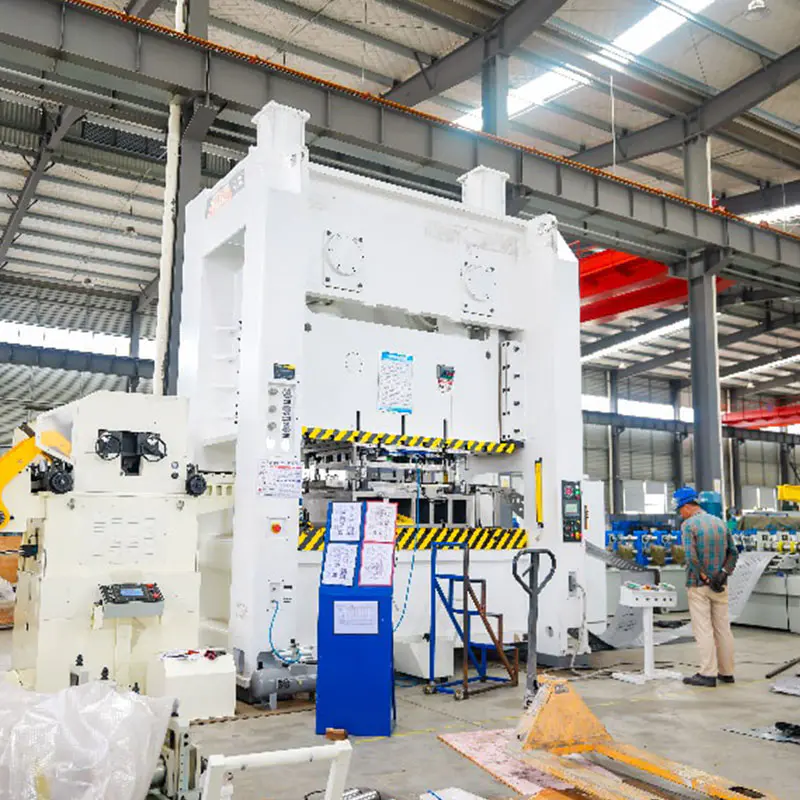
Decoiler System 3-in-1 Decoiler Straightener Feeder Capacity: 5 tons hydraulic coil mandrel expansion, servo feeding & straightening. Punching machine 400 Ton Power Press Capacity: ...
See Details
wide material single decoiler Leveling machine and Machine for punching small holes on both sides All the upper and lower rollers are connected to a worm gear reducer.This makes the for...
See Details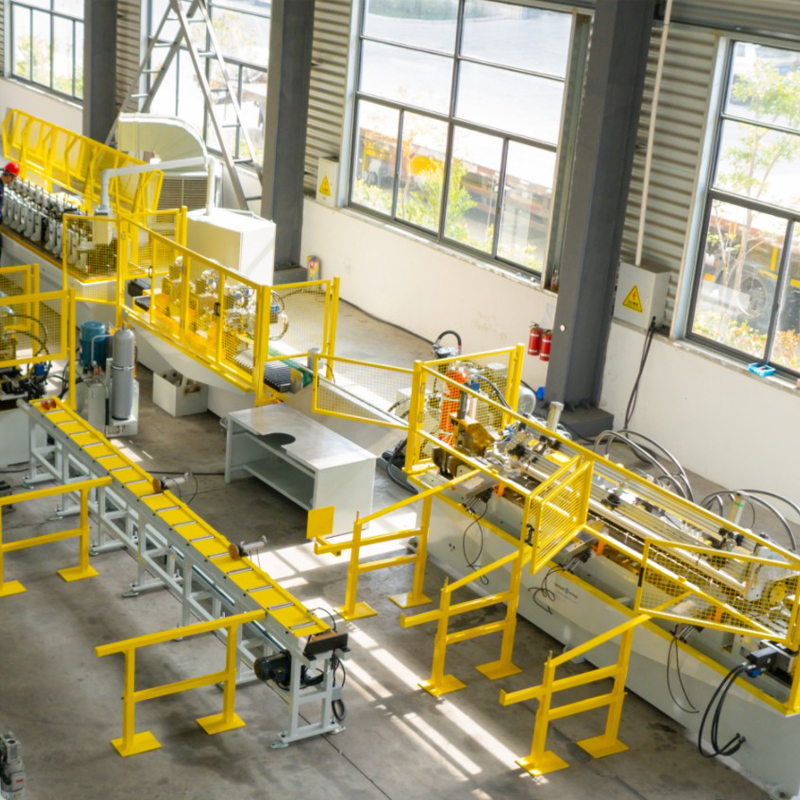
Strut cassette roll forming machine Single-head 3-ton decoiler Leveling machine(A leveling machine is required before using a punch press.) Yadon/Yangli 125-ton press machine (opti...
See Details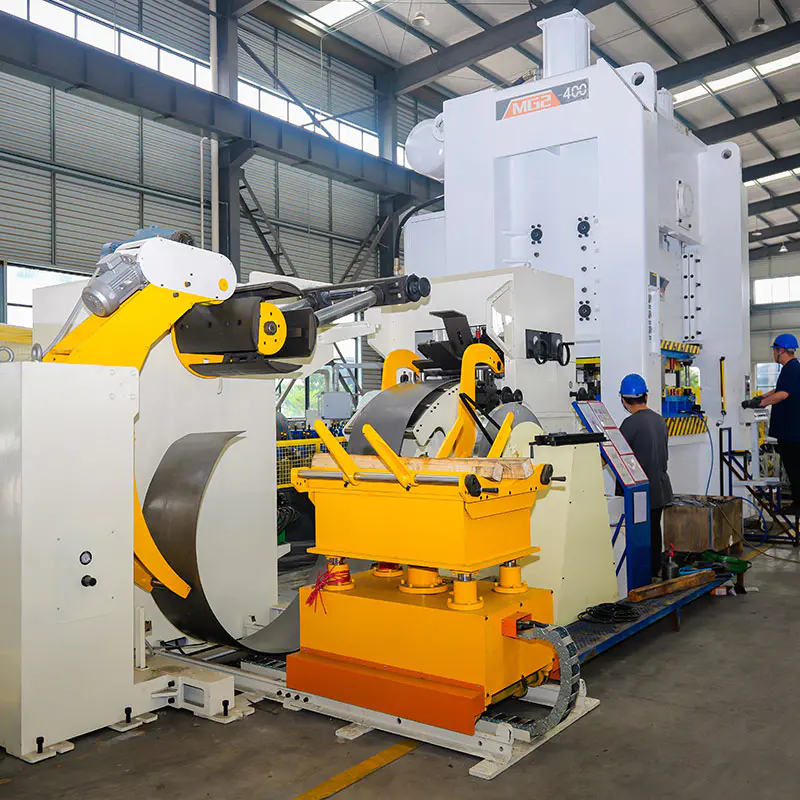
3-in-1 Decoiler Straightener Feeder System · 3-in-1 Decoiler Straightener Feeder capacity: 5 tons Hydraulic mandrel expansion Servo-driven straightening & feeding Synchronized signal wit...
See Details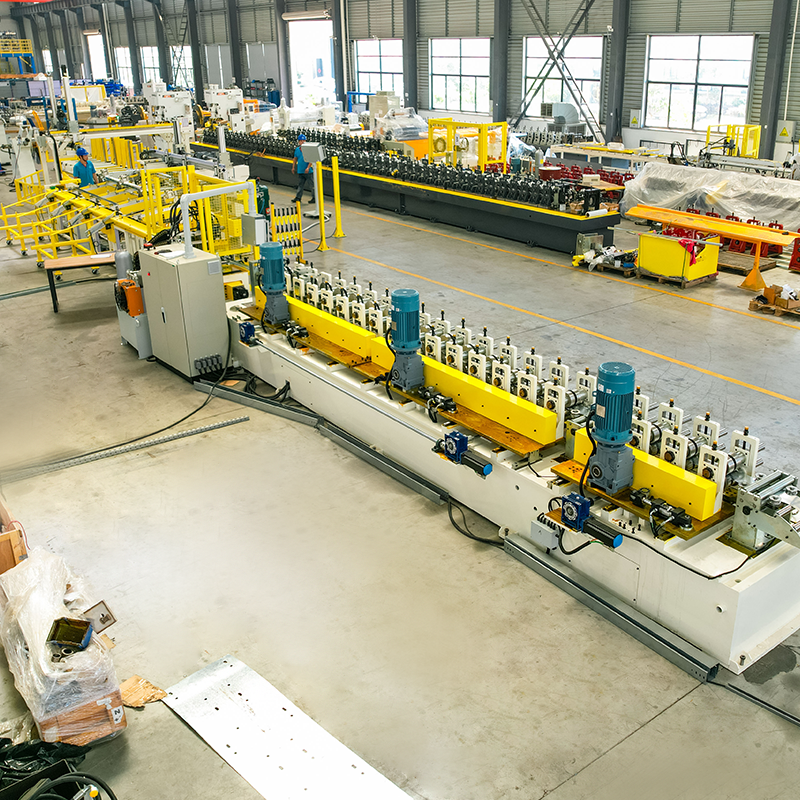
CU automatic width-change roll forming machine, chain drive, automatic packing. Economical double-head hydraulic decoiler, 3 tons per side, manual brake Automatic width and height chang...
See DetailsDon't hesitate to contact when you need us!
Contact Information
PRODUCTS
Mobile


 English
 Español
 русский