Content
Roll forming high strength steel (HSS) and advanced high strength steel (AHSS) means passing flat coil stock through a series of progressively shaped rollers, each bending the material a few degrees further, until it reaches the final cross-sectional profile. Because the deformation happens gradually across many roller stations rather than in one stroke, roll forming keeps stress on the material more evenly distributed than single-hit forming methods, which is a major reason it's the preferred process for AHSS grades that crack more easily under sudden, concentrated force.
HSS and AHSS grades — including dual-phase (DP), transformation-induced plasticity (TRIP), and martensitic steels — offer tensile strengths ranging from roughly 440 MPa up to 1,500+ MPa, compared to 270-400 MPa for conventional mild steel. That strength lets automakers use thinner gauge material for the same structural performance, directly supporting vehicle weight reduction targets without sacrificing crash safety.
In automotive manufacturing, the roll forming line typically follows this sequence:
This continuous, high-volume nature is what makes roll forming particularly well suited to automotive production, where the same structural profile — door beams, bumper reinforcements, roof rails, or seat frame components — may need to run in the tens or hundreds of thousands of linear feet per year.
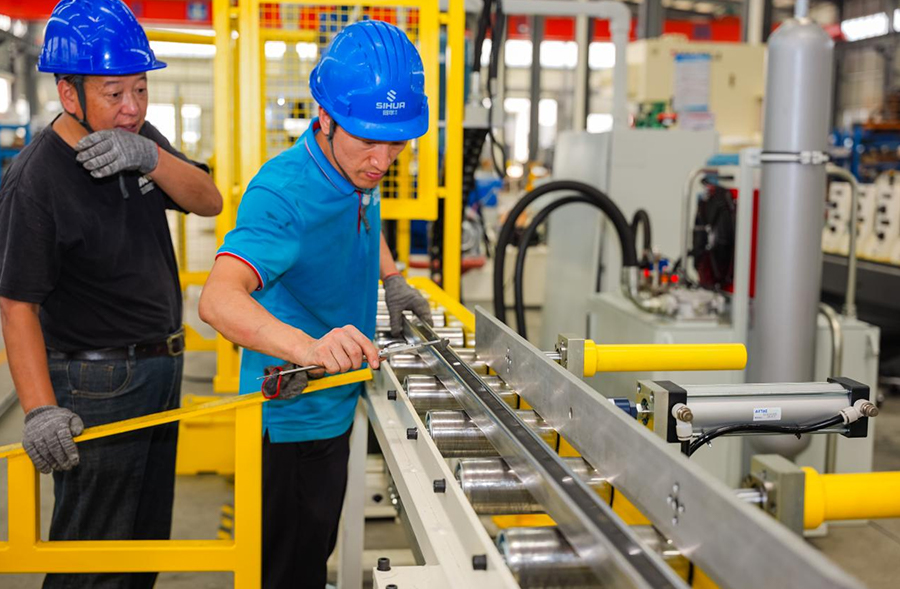
Roll forming and stamping both shape flat steel into structural parts, but they suit different part geometries and production profiles.
| Factor | Roll Forming | Stamping |
|---|---|---|
| Part geometry | Best for long, constant-profile linear parts | Best for complex, non-linear or 3D shapes |
| Stress on material | Gradual, distributed across many stations | Concentrated, applied in a single stroke |
| AHSS suitability | Well suited, lower cracking risk | More prone to splitting on high-strength grades |
| Tooling cost per part | Lower for long production runs | Higher die cost, better for complex low-volume parts |
Roll forming and stamping compared for structural automotive part production.
For AHSS specifically, roll forming's gradual, multi-station bending is a major advantage over stamping's single-hit deformation, since AHSS grades generally have lower elongation before fracture and are more sensitive to the strain rate and stress concentration a stamping die applies in one motion.
Tooling design for AHSS roll forming differs from mild steel tooling in several ways, driven by the higher forming forces and springback the material generates:
Springback is the tendency of formed metal to partially return toward its original flat shape after the forming force is removed, caused by the elastic recovery portion of the material's deformation. Higher strength steels generally have a higher yield strength relative to their elastic modulus, which means a larger share of the total deformation is elastic (recoverable) rather than plastic (permanent) — so AHSS springs back more than mild steel bent to the same angle.
Roll forming lines address springback primarily through over-bending: each roller station bends the material slightly past the target angle, anticipating the amount it will relax back once released. The exact over-bend angle is typically determined through a combination of forming simulation software and physical trial runs, since springback varies by steel grade, gauge thickness, and profile geometry, and even small changes in coil-to-coil material properties can shift the amount of correction needed.

wide material single decoiler Leveling machine and Machine for punching small holes on both sides All the upper and lower rollers are connected to a worm gear reducer.This makes the for...
See Details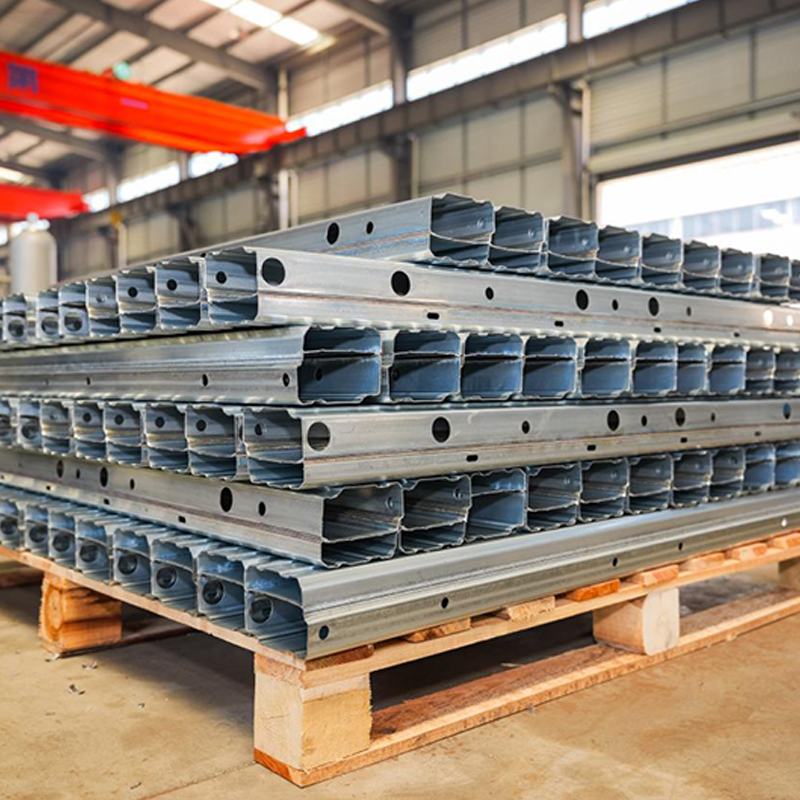
The production line for vehicle B-profile automotive chassis reinforcement beams involves several key processes to ensure High-strength, precision, and durability for vehicle applications. Key e...
See Details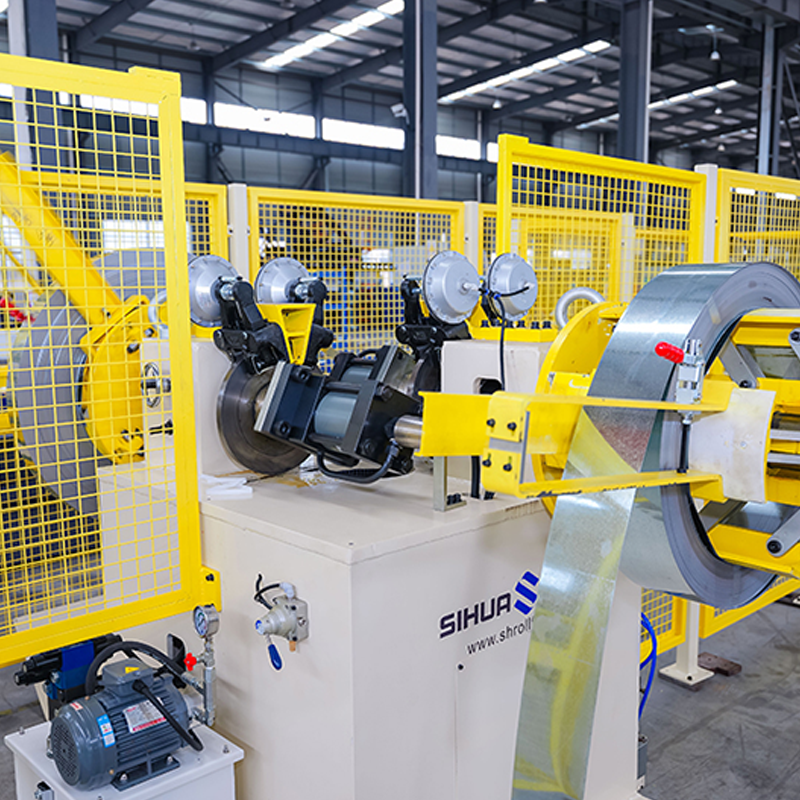
Automatic rotating double-head hydraulic decoiler with no-material detection, 5 tons per side. Laser power and welding length are adjustable to accommodate steel strips of various thicknesse...
See Details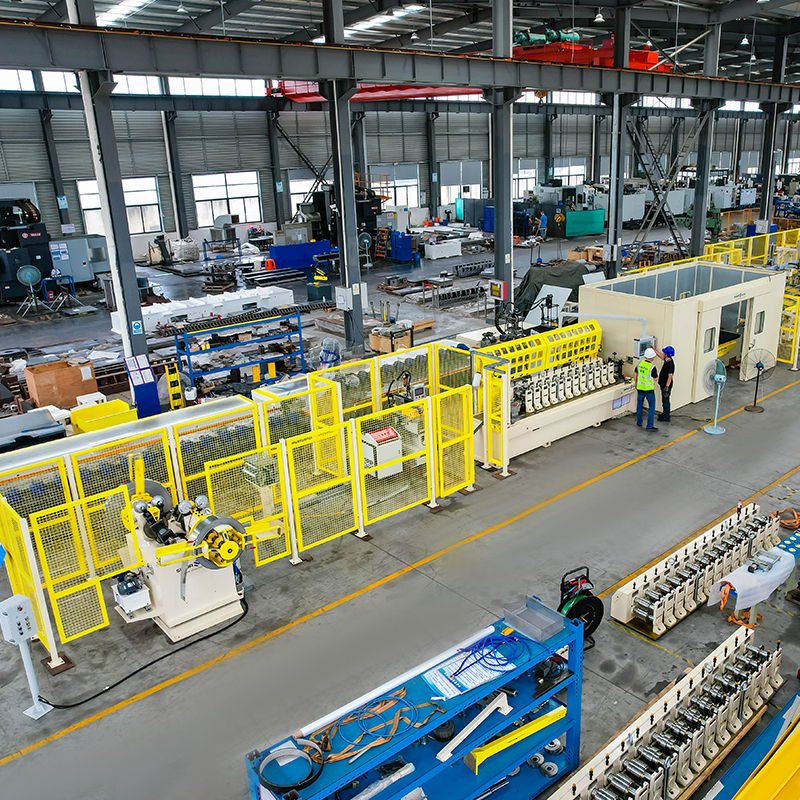
Automatic rotating double-head hydraulic decoiler with no-material detection, 5 tons per side. Quick-change cassette roll forming machine (changeover takes 30 minutes). Cutting without ...
See Details
Double-head pre-painted steel hydraulic expanding/contracting uncoiler, double-head galvanized steel expanding/contracting uncoiler, pre-painted steel storage bracket, belt reduction. The 5-...
See Details
Solar bracket auto change width roll forming machine Material decoiler with storage platform and robotic arm Leveling machine(A leveling machine is required before using a punch press.)...
See DetailsDon't hesitate to contact when you need us!
Contact Information
PRODUCTS
Mobile


 English
 Español
 русский