Content
A roll forming line can shear a finished profile every few seconds, yet the last ten metres of the plant are often still manual. One operator counts the sections, another squares the bundle by hand, a third walks a strapping tool around it, and the pack is finally wrapped in stretch film before it reaches the warehouse.
An automatic metal profile packing machine replaces that sequence with one coordinated end-of-line unit. It receives cut-to-length profiles from the run-out table, straps them into fixed bundles, stacks the bundles to a preset pattern, and wraps them for transport, all without lifting the profiles a second time. This article explains how inline strapping, stacking, and wrapping integration works, what to specify, and which design decisions actually change your operating cost.
Many plants already automate forming, punching, and cutting, then stop at the run-out table. The result is a line that can produce faster than it can pack, and a packing station that quietly sets the real output of the whole factory.
Three problems appear again and again when packing stays manual:
An inline packer avoids all three because it stays inside the line's control rhythm. It works at line speed, applies the same strap pattern to every bundle, and hands the pack over without another lift. Compared with an offline packer fed from a stack, the inline arrangement removes an entire handling step, and in most cost audits that step is exactly where the labour budget sits. The installed project cases show how these end-of-line units are arranged on real production floors.
A packing machine is best understood as three modules sharing one frame, one control cabinet, and one recipe library. Each module has a clear job, and each one can be specified separately without breaking the integration.
Feeds, tensions, seals, and cuts one to six straps per bundle. Strap count, pitch, and tension follow the profile instead of the operator's judgement.
Counts sections, forms layers, aligns bundle edges, and releases each pack to the wrapper at a fixed interval.
Applies stretch film, VCI paper, or both with controlled overlap and a sealed or taped tail for weather protection.
Because the modules share a controller, the settings travel together. Select a 3 m strut bundle recipe and the strapping pitch, the stack count, and the film overlap all change in one step rather than three. That single point of change is what makes short-run production practical.
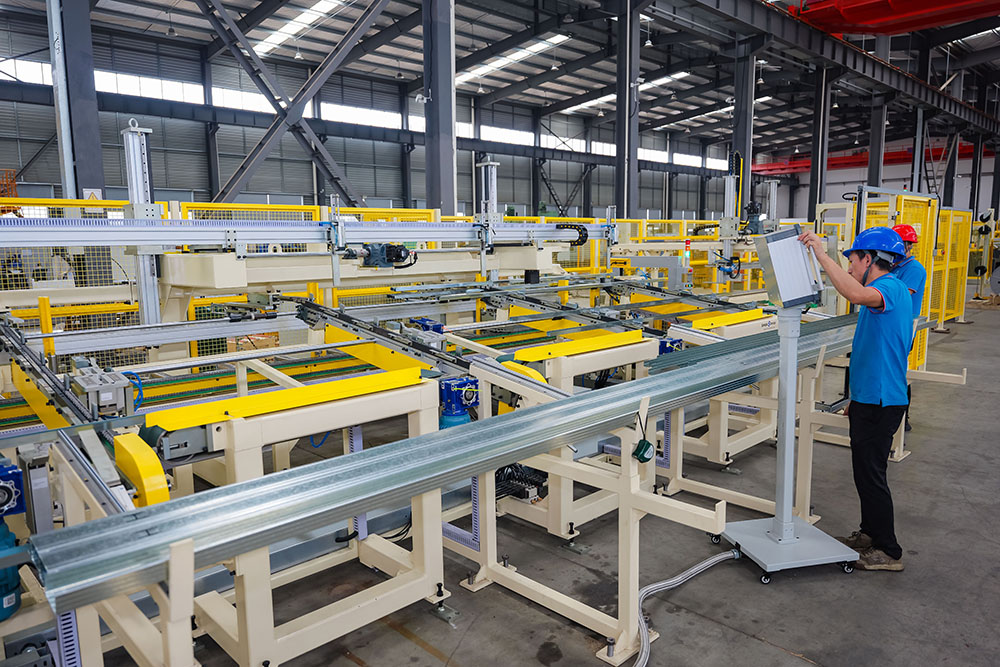 Automatic Metal Profile Packing and Wrapping SystemView this automated packing, wrapping, and sealing system for metal profiles, with shared recipe control and inline strapping that support short-run production.View Product →
Strapping is the module that decides whether a bundle survives the truck. In an inline arrangement the strap is fed around the bundle, tensioned, sealed, and cut inside a cycle measured in seconds, and the bundle never leaves the conveyor.
Long profiles need more than one strap. A practical starting point is one strap per 600 to 900 mm of bundle length, with the outer straps set back from the ends so they cannot slide off during handling. A 6 m purlin bundle normally takes four to six straps, while a 3 m stud bundle is secure with two or three.
Thin-walled drywall profiles and open strut sections deform under excess tension. Servo-driven tensioning with a programmable set point lets the same machine strap a 0.5 mm stud and a 2.5 mm purlin without crushing either one, because the operator changes a number rather than a mechanical spring.
| Material | Behaviour | Best suited to | Watch out for |
|---|---|---|---|
| PET | High strength, low elongation, holds tension on rigid loads | Purlins, rack uprights, cable tray, export bundles | Needs sharp-edge protection on thin sections |
| PP | Lower strength, higher elongation, lowest cost | Light drywall studs and tracks, short bundles | Can relax over time in long storage |
| Steel | Highest strength, minimal stretch | Heavy structural bundles and long transport routes | Sharp edges, rust risk, customer restrictions |
Stacking is the quiet module. If the count is wrong, everything downstream is wrong, and the error usually surfaces at the customer's site rather than in your own yard.
Counting is normally handled by a photoelectric sensor at the run-out table or by an encoder-linked length counter on the shear, with a verification sensor at the stacker. A mismatch stops the line before a short bundle is wrapped, which is far cheaper than a claim six weeks later.
Bundle weight is the constraint that is most often missed during planning. If a bundle of 6 m purlins reaches 1.5 t, the stacker, the wrapper, the discharge conveyor, and the forklift all have to be sized for it, and the line may need a skid or pallet station at the discharge end. Deciding this early is far easier than modifying a conveyor later.
Alignment quality also depends on the side guides and the drop height from the shear. A short, controlled drop keeps layer edges square, which in turn lets the strapping head sit closer to the bundle and produce a tighter pack.
Wrapping is often treated as an afterthought, but it is the module that determines how the bundle looks after a month in a warehouse or a week on a flatbed.
Stretch film suits general handling and short storage. VCI paper suits galvanised or pre-painted surfaces that will sit in humid conditions, and many lines run film over paper for a combined barrier. The parameters worth fixing in the specification are overlap percentage, number of wraps, film tension, and whether the tail is heat sealed or taped.
One layout decision deserves early attention: whether the wrapper runs directly in line with the stacker or sits behind a short buffer. In-line wrapping is compact and fast. A buffer station lets the line keep forming while the wrapper finishes a pack, which helps whenever the wrap cycle is longer than the pack cycle. A label applicator printing bundle ID, profile code, length, quantity, and production date is normally mounted at this point.
The packer is only truly automatic if it talks to the line. A workable specification includes four integration points:
Where the line includes inline punching, the same logic applies upstream. A servo punching unit runs in line with the roll former and the packer under a single recipe, and the working principle of an 8-axis servo punching machine is a useful reference for how that control handshake is arranged.
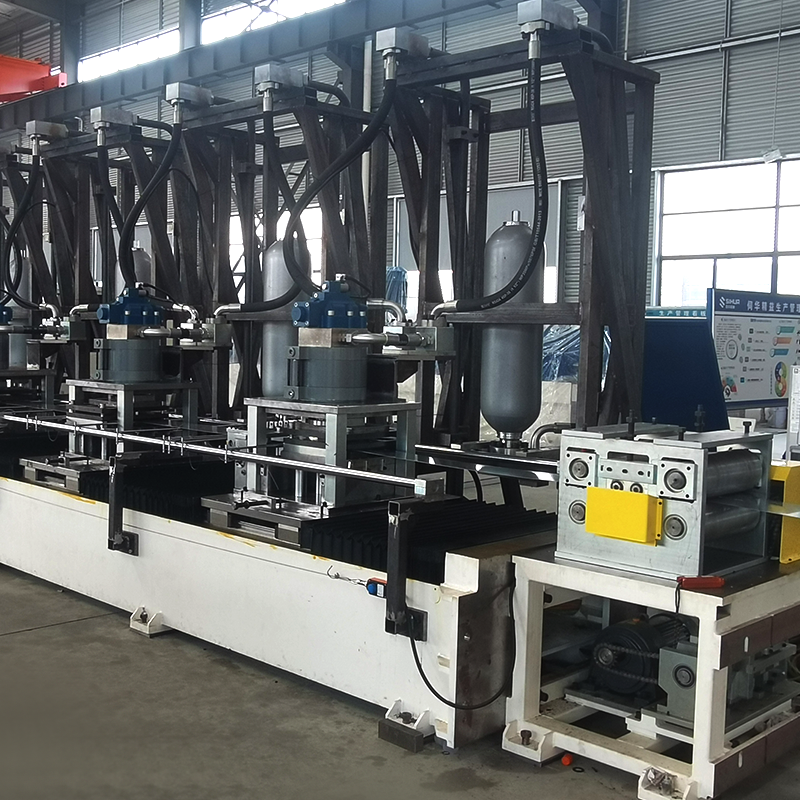 8-Axis Servo Punching Machine for Inline ProductionReview this high-precision servo punching system for complex multi-angle work, PLC touchscreen control, and fast software changeover in metal fabrication lines.View Product →
Most quotation problems come from an incomplete profile list rather than from the machine itself. The table below covers the data a supplier needs to size the three modules correctly.
| Parameter | What to define | Why it matters |
|---|---|---|
| Profile range | Width, height, and thickness limits | Sets guide width, strap arch size, and tension range |
| Bundle length | Typical and maximum cut length | Determines strap count and stacker footprint |
| Bundle weight | Target weight per pack | Sizes conveyor, wrapper, and lifting equipment |
| Line speed | Running speed and shear cycle | Defines buffer capacity and pack cycle time |
| Strap pattern | Count, pitch, and material | Controls tension settings and edge protection |
| Wrapping method | Film, paper, or both | Matches storage and shipping conditions |
| Changeover | Number of sizes per shift | Justifies recipe memory and motorised guides |
The same architecture suits most open profiles produced on a roll forming line, though the settings differ considerably:
Very long, very heavy, or closed hollow sections usually need a modified strap arch or a different strap path. This is why the profile drawing, not just the profile name, should be part of the enquiry.
Payback normally comes from three lines rather than one:
Consumables move the other way. Automatic tensioning usually reduces strap consumption compared with hand tools, because every strap is cut to the same length and tensioned once rather than re-tensioned after slipping. Ask for consumption per bundle in the quotation and compare it against your current monthly figures.
It is an end-of-line system that receives cut-to-length metal profiles and performs strapping, stacking, and wrapping in one continuous cycle, with settings recalled from a recipe rather than set by hand for each bundle.
In most cases yes, provided the run-out table has space for the stacker and the line controller can exchange cut and bundle-complete signals. A survey of the discharge area and the existing PLC program is the normal first step.
PET is the safer default for rigid steel bundles because it stretches less and holds tension during transport. PP remains economical for light drywall profiles and short bundles where load retention is less demanding.
A practical starting point is one strap per 600 to 900 mm of bundle length, with the outer straps set back from the ends. Long purlins and heavy rack uprights usually need the upper end of that range or more.
With motorised guides and recipe recall, a width or strap-pattern change is typically a few minutes. Without recipe memory, the same change becomes a manual setup that can run well past ten minutes.
A packing machine is a line component, not a standalone box at the end of the shed. When inline strapping, stacking, and wrapping share a controller with the shear and the punch unit, they behave as one system: bundles are identical, the mill runs at design speed, and the profiles are never lifted by hand.
The practical route is to define the profile range, bundle weight, strap pattern, wrapping method, and control handshake in a single specification document. With those five items settled, the three modules will integrate cleanly, and the end of the line stops being the slowest part of the plant.
Metal Scaffold decking roll forming machine Shaft diameter: 70–80 mm; scaffold decking length: 0.5–6 m; thickness: 1–2.5 mm. Equipment layout diagram.We welcome you to send us your factory's...
See Details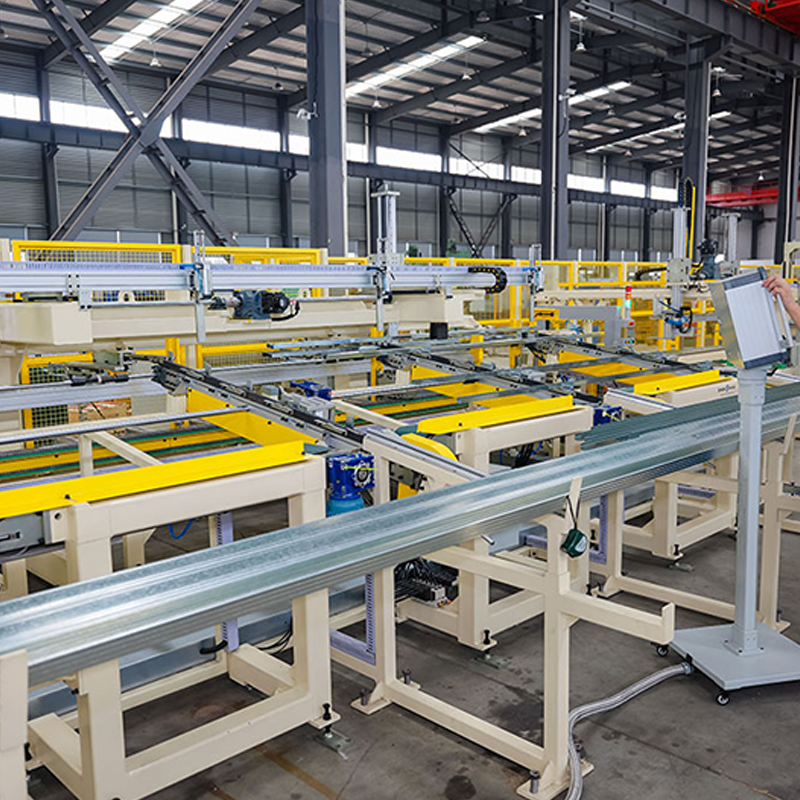
Automatic button flipping machine Flipping speed: 120 meters per minute. Flips the metal profile and snaps it on. Small bundle packing machine Large bundle palletizer Large-bu...
See Details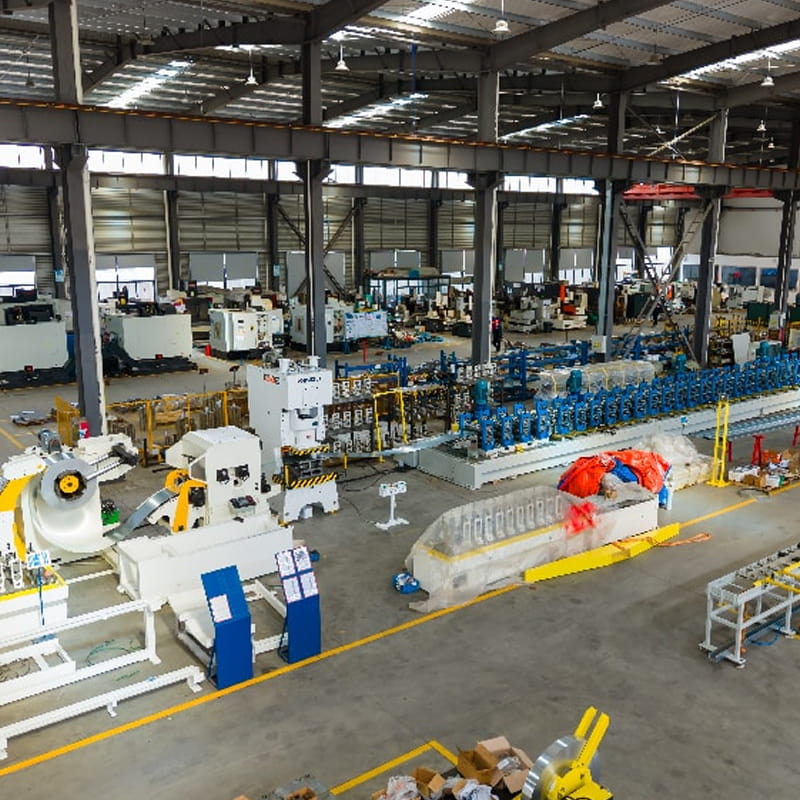
An automatic C-U-sigma multi-profile roll forming production line can produce various structural profiles of C, U, and sigma types. It adopts a 3-in-1 feed rack integrating decoiling, leveling, and fe...
See Details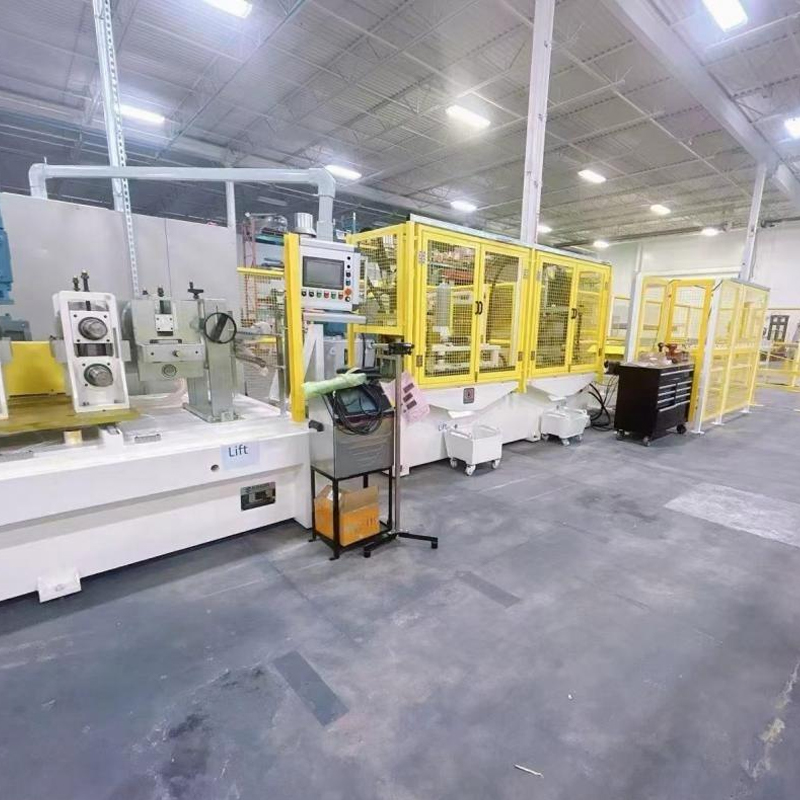
3.0 mm automatic change C- and U-frame profile roll forming line, designed speed 63 75 m, actual production speed 15 35 m/min, for C channel and U channel frame profiles with width 200 400mm. It is eq...
See Details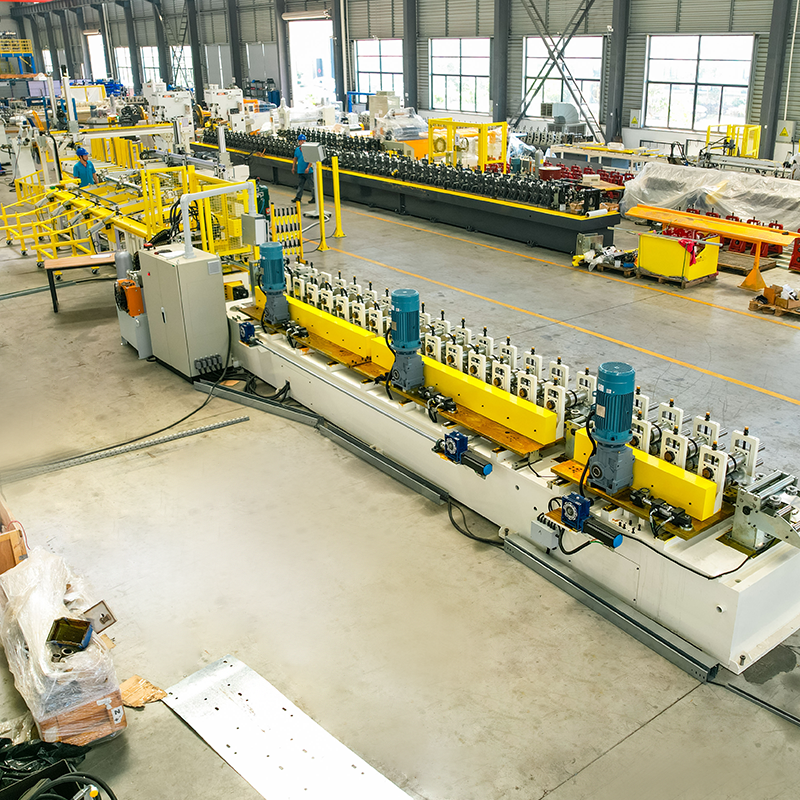
CU automatic width-change roll forming machine, chain drive, automatic packing. Economical double-head hydraulic decoiler, 3 tons per side, manual brake Automatic width and height chang...
See Details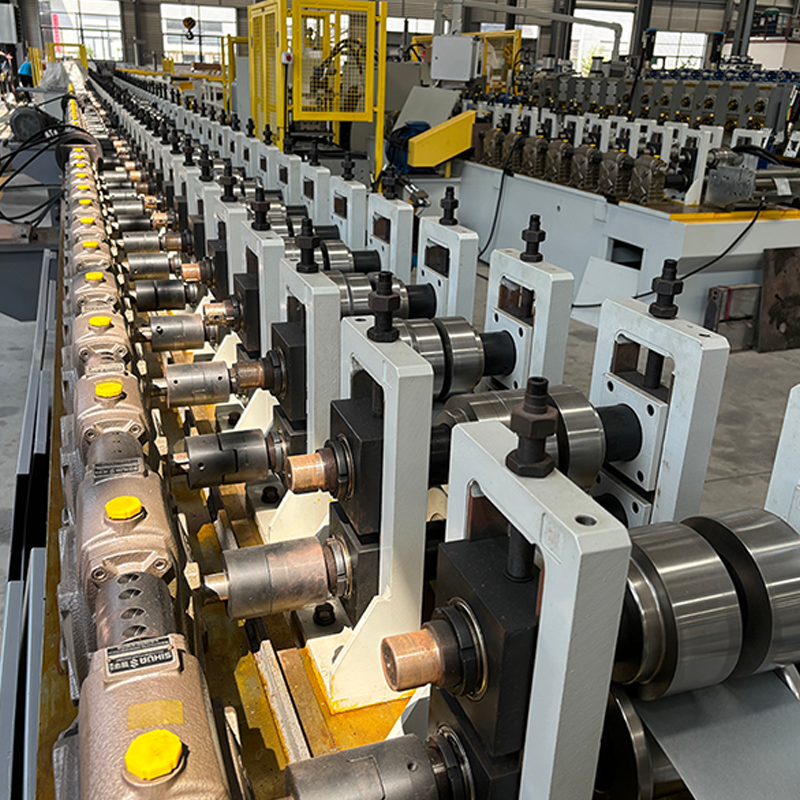
PV frame window door profile roll forming machine Worm gear reducers with different reduction ratios can be selected to achieve different production speeds. Straightening seats are used t...
See DetailsDon't hesitate to contact when you need us!
Contact Information
PRODUCTS
Mobile


 English
 Español
 русский